
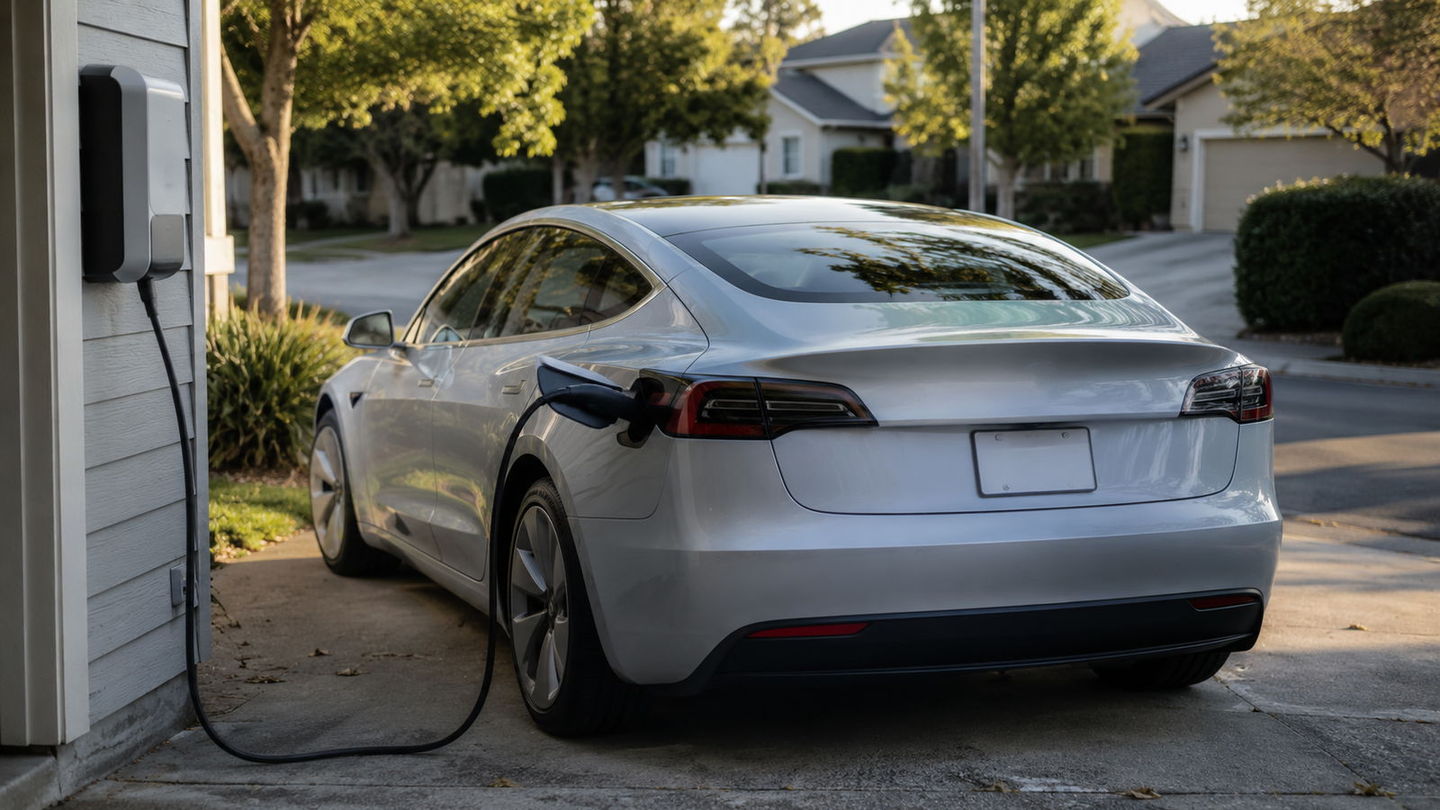
What an EV Really Costs at the DMV — State Registration Surcharges Explained
You bought an electric car partly because you were done paying for gas. Then the registration renewal arrived and there was a line on it you had never seen before, for a couple of hundred dollars, with a name like "electric vehicle road use fee". It is not a mistake and it is not a penalty. It is a state trying to solve an arithmetic problem, and understanding the arithmetic tells you a lot about what your renewal will look like in five years.
Why the fee exists
American roads are paid for, in large part, by a tax on motor fuel. You do not see it as a line item — it is baked into the price at the pump, split between a federal share and a state share, and every time you fill up you are contributing to the maintenance of the road you are standing on.
The system has an obvious flaw, and it took decades to become urgent: it charges you for burning fuel rather than for using road. A heavy vehicle that never visits a pump does exactly the same damage to a highway surface as one that does, and pays nothing toward repairing it.
For a long time this was a rounding error. It is not any more. So states did the straightforward thing and attached a flat charge to the one moment they reliably interact with every vehicle owner: registration renewal. The federal fuel tax share is untouched by all this — these are state fees, set by state legislatures, and they vary enormously as a result.
The four shapes these fees take
Once you know the four patterns, any state's rules become readable.
- A flat annual EV fee. The most common approach by a wide margin. Battery electric vehicles pay a fixed amount on top of normal registration, every year, regardless of how much they are driven.
- A reduced fee for plug-in hybrids. Most states that charge EVs also charge plug-in hybrids, usually around half, on the reasoning that a hybrid still buys some fuel and therefore still pays some fuel tax. Conventional hybrids with no plug are usually exempt, but not always.
- A fee that escalates automatically. Several states wrote inflation indexing into the statute, so the figure rises each year without a new vote. This is the one that catches people out: the number on your renewal is not the number you paid last year, and no letter arrived to warn you.
- A per-kilowatt-hour charge on public charging. A smaller group taxes electricity delivered by commercial charging stations instead of, or as well as, charging a registration fee. If your state does this, you are already paying it and it is invisible, folded into the price per kWh at the charger.
A few states charge nothing at all, and a couple have unusual hybrids of the above — an extra charge based on vehicle value, or a weight-based schedule that catches heavier electric SUVs and trucks harder than compact cars.
How much you should expect to pay
Across the states that charge one, a full battery electric vehicle typically lands somewhere between $50 and $250 a year, with the bulk clustered around $100 to $200 and plug-in hybrids usually paying roughly half. A handful of states sit above that range, and a handful charge nothing.
We are deliberately not printing a fifty-state table of exact figures here, and it is worth explaining why rather than pretending the omission is an oversight. These numbers are among the most volatile in all of vehicle registration. They are set by legislatures, several of them index automatically to inflation, and any table published today is quietly wrong within a year while continuing to look authoritative. There are sites that publish one anyway. Cross-check anything you find on one against the state itself before you rely on it.
What is stable, and genuinely useful to know, is the shape of the thing:
- The fee is charged annually at renewal, not once at purchase, in nearly every state that has one.
- Some states also charge a larger amount at initial registration when the vehicle first enters the state, which is why the first bill after buying can be a shock.
- The fee is on top of everything you would pay anyway — base registration, any value-based tax, plate fees, and inspection.
- It is not prorated by mileage. Drive two thousand miles a year or thirty thousand, you pay the same.
Is it actually fair?
This is where the topic gets genuinely contested, and both sides have a real point.
The case for the fees is simple and hard to argue with: roads cost money, everyone who uses them should contribute, and a driver who pays nothing is being subsidized by their neighbors. Framed that way, an EV fee is not a punishment for going electric. It is a correction to an accounting method that assumed all vehicles burn fuel.
The case against is about calibration rather than principle. Because the fees are flat, a low-mileage EV driver frequently pays more than a high-mileage gasoline driver contributes in fuel tax over the same year — the opposite of what a road-use charge is supposed to do. Independent analyses have repeatedly found that several states set their flat fee well above what an equivalent gasoline vehicle actually pays at the pump. There is also a timing objection: the charge arrives as one visible lump at renewal, while fuel tax is invisible and spread across fifty small purchases, which makes an economically similar burden feel much heavier.
The direction of travel is toward mileage-based road user charges, where you pay for the miles you actually drive regardless of what powers the car. Several states have run voluntary pilots. It is fairer in theory and it raises privacy questions that flat fees do not, which is a large part of why it has not spread faster.
Finding the exact figure for your state
There is one reliable method and it takes about two minutes.
- Go to your state's page in our state directory and follow the official agency link at the top of it. That link goes to the agency itself, not to a third party.
- Find the registration fee schedule. Look for "fee schedule", "registration fees" or "vehicle fees". The EV surcharge is nearly always listed as a separate line rather than folded into the base rate.
- Check which category your car is in. Battery electric, plug-in hybrid and conventional hybrid are charged differently, and a plug-in hybrid misfiled as a full EV is a common and expensive error on a renewal notice.
- Look for an escalator clause. If the schedule mentions annual adjustment or indexing, the figure you are reading is this year's, not next year's.
If you are moving states with an EV, check the new state's fee before the move, not after. The surcharge can be several hundred dollars, it is charged when you first register there, and it lands in the same fortnight as everything else on your relocation checklist. Our guide to moving to another state covers the sequence.
Budgeting for it properly
The mistake is not paying the fee. It is being surprised by it, which happens because people compare the running costs of an EV against a gasoline car using only the fuel line.
Do the comparison honestly and the picture is usually still favorable, just less dramatic than the marketing suggested. Take your state's annual EV fee, add any charging tax you pay per kWh, and set that against what you would have spent on gasoline for the same miles. For most drivers doing average mileage, the EV still wins comfortably. For someone driving very little, the flat fee can genuinely erode the advantage, which is worth knowing before you buy rather than after.
One practical note: the surcharge is due at renewal along with everything else, and in most states an unpaid registration is an unpaid registration regardless of which line caused it. Letting it lapse over a fee you did not expect risks a citation and, in some states, a penalty that grows monthly. If your renewal looks wrong, call the agency before the deadline rather than after it.