
REAL ID One Year Later — What Actually Happens at the Airport Without One
For twenty years the REAL ID deadline was the thing that was always about to happen. It was set, postponed, reset, postponed again, and by the time it genuinely arrived in May 2025 a good number of Americans had stopped believing in it. Then it arrived, and the airports did not melt down. Here is what the rule actually does, what happens at the checkpoint if your license has no star on it, and who still needs to book that DMV appointment.
What REAL ID actually is
The REAL ID Act was passed in 2005, on the recommendation of the 9/11 Commission, and it does something narrower than most people assume. It does not create a national identity card. It does not give the federal government a new database of drivers. What it does is set minimum standards that a state has to meet before a federal agency will accept the license that state issues as proof of who you are.
Those standards are mostly about what the state checks before it prints the card: verifying your identity document against the issuing source, confirming your Social Security number, confirming lawful status, and confirming two proofs of address. A state that does all of that can mark its cards as compliant, and the mark is usually a star in the top right corner. Not always a plain one — California uses a golden bear with a star inside it, which has confused a fair number of Californians into thinking they are not compliant.
The mark matters in exactly two situations: boarding a commercial domestic flight, and entering a federal facility or nuclear power plant that requires identification. That is the whole list. It has nothing to do with driving, nothing to do with being pulled over, nothing to do with buying alcohol, and nothing to do with proving you can work.
The star does not affect your driving privileges. A non-compliant license is a completely valid license. You can drive on it, rent a car on it, and get pulled over on it with exactly the same consequences as anyone else. The only thing it will not do is get you through airport security on its own.
What happens at the checkpoint without one
This is the part the panic coverage got most wrong, and it is worth being precise about, because "you will be turned away" and "you will be delayed" are very different problems for someone with a 7am flight.
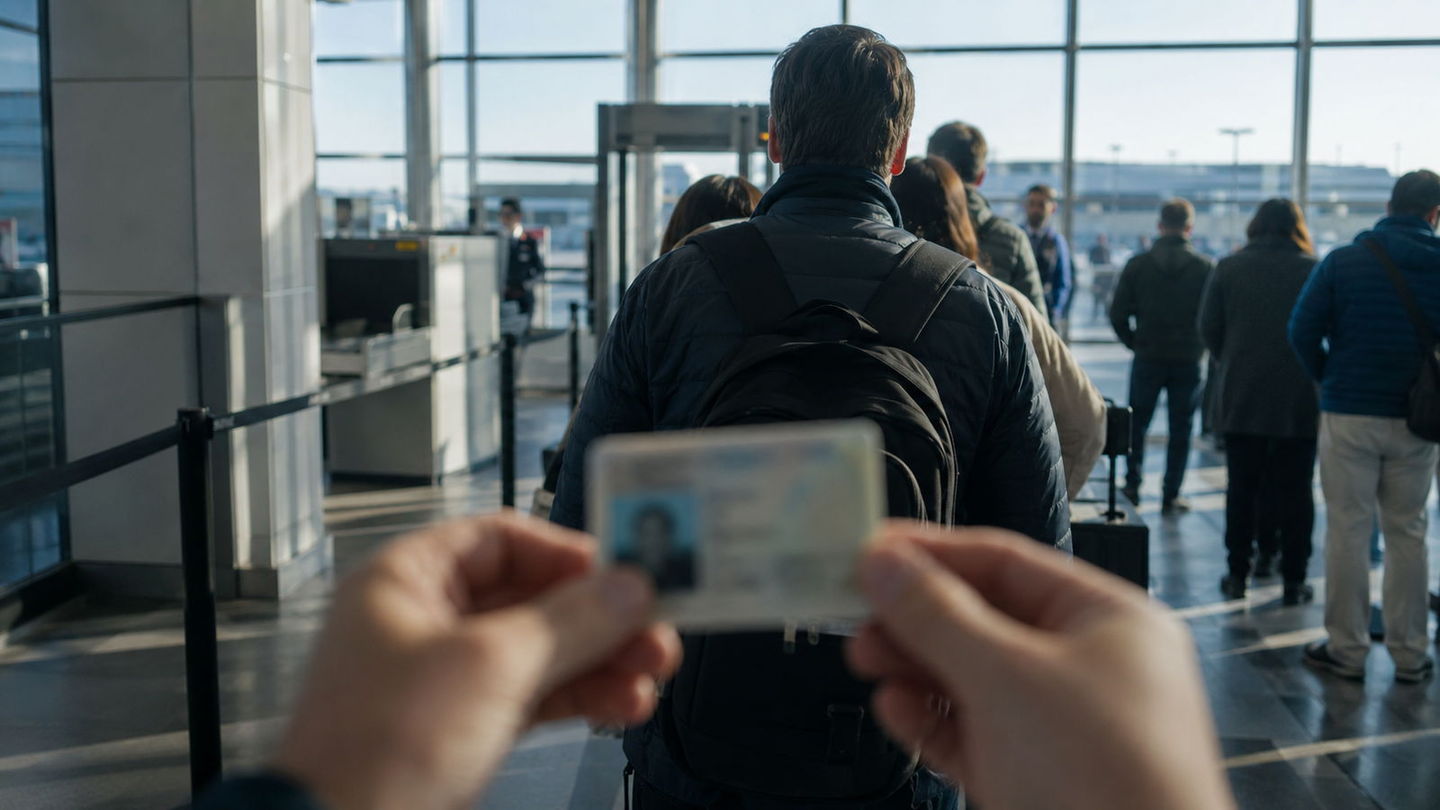
When enforcement began, TSA did not adopt a hard refusal. The approach has been a phased one: a traveler who shows up with a non-compliant license and no acceptable alternative is not automatically sent home. They are identified through a separate process, which in practice means being pulled aside, having their identity verified another way, and going through additional screening. It takes longer. Sometimes considerably longer.
Two things follow from that, and both are worth internalizing.
The first is that "phased" is not "permanent". A phase-in exists so that it can end. Planning your travel around the assumption that additional screening will always be available is planning around a temporary accommodation, and TSA has been explicit that travelers should expect delays and should not count on it indefinitely. Before you fly on a non-compliant license, check the current position on TSA's identification page rather than on a news article from last year.
The second is that there is a separate process for having no ID at all, which has existed for years and is unchanged. If your wallet is stolen the night before a flight, you are not stranded: you tell the officer, you complete an identity verification process, and if it succeeds you fly. It is slow, it is not guaranteed, and it is not a strategy — but it is a genuine safety net, and a surprising number of people do not know it exists.
The documents that work just as well
Here is the single most useful fact in this article, and the one that dissolves most of the anxiety around the deadline: REAL ID is not the only acceptable document, and it never was. The list of identification TSA accepts at the checkpoint is long, and if you hold any one of these, the star on your license is irrelevant to you.
- A U.S. passport, or a U.S. passport card — the card is cheaper, fits in a wallet, and is valid for domestic flights.
- A DHS trusted traveler card: Global Entry, NEXUS, SENTRI or FAST.
- An enhanced driver's license, issued by Michigan, Minnesota, New York, Vermont and Washington. These are separate from and stronger than a REAL ID license — they also work for land and sea crossings to Canada and Mexico.
- A U.S. Department of Defense ID, including dependents' IDs.
- A permanent resident card.
- A border crossing card.
- A photo ID issued by a federally recognized tribal nation.
- A foreign government-issued passport.
- A Transportation Worker Identification Credential (TWIC).
- A USCIS Employment Authorization Card (I-766).
- A U.S. Merchant Mariner Credential, or a Veteran Health Identification Card.
The passport card deserves a mention on its own, because it is the answer for a specific kind of person: someone who does not want to make a DMV appointment, does not have a current passport book, and flies domestically a couple of times a year. It costs less than a passport book, arrives by mail, and does the job at the checkpoint indefinitely. It will not get you on an international flight, which is the trade-off.
Children are not affected. TSA does not require identification from passengers under 18 travelling within the United States with a companion. If you have been worrying about a teenager without a compliant license, stop.
Who genuinely needs to act
Strip away the noise and the group with a real problem is narrow. You need to do something if all of the following are true: you are 18 or over, you fly domestically or need to enter a federal facility, your driver's license or state ID has no compliance mark, and you hold none of the alternative documents above.
If that is you, you have two routes. Get a compliant license at your state agency, which means an in-person visit with original documents. Or apply for a passport card, which means a form, photos and a wait, but no appointment. Neither is urgent in the sense the coverage implied, and both are worth doing before you next book a flight rather than the week of it.
If you have a current U.S. passport sitting in a drawer, you are done. You have been done since 2005.
Getting one without wasting a morning
Upgrading to a compliant license is not complicated, but it is unforgiving about paperwork, and it is the one DMV transaction where turning up with the wrong document is guaranteed to end the visit. You cannot do it online in any state, because the whole point of the standard is that a human being verifies original documents.
What every state asks for follows the same shape:
- One proof of identity and lawful status. A certified birth certificate with a raised seal, or a valid U.S. passport. A hospital souvenir certificate is not a birth certificate and gets rejected constantly.
- Proof of your Social Security number. The card itself, a W-2, or an SSA-1099. It must show the full number, which rules out most pay stubs.
- Two proofs of your address, from two different sources, usually dated within the last 60 to 90 days. Utility bills, bank statements, a lease, a mortgage statement. A magazine wrapper is not a utility bill.
- Proof of every name change between the two, if your birth certificate does not match the name you use. Marriage certificates and court orders, in an unbroken chain. This is the requirement that sends more people home than any other.
That last point is worth dwelling on because it disproportionately affects women who changed their name at marriage, sometimes more than once. The chain has to be complete: birth certificate to first marriage certificate to divorce decree to second marriage certificate. A gap anywhere in it means a second trip. Assemble the whole sequence on your kitchen table before you leave the house.
Requirements vary in the details from state to state, and the current document checklist always lives on your own agency's site. Ours are collected by state in the state guides, and the general procedure is in our driver's license guide and license renewal guide.
Four things people still get wrong
"My license expires in 2029, so I have until then." Your license stays valid until it expires, and the star is unrelated to that. You can upgrade at any point, including at your normal renewal. What you cannot do is assume the upgrade happens automatically at renewal — in several states you must request it and bring the documents, or you will be issued another non-compliant card.
"REAL ID is a national ID card." It is a standard your state's card meets, issued by your state, held in your state's system. There is no federal REAL ID database, and no federal REAL ID card.
"I need it to drive." No. It has no connection to driving privileges whatsoever.
"The deadline will move again." It did not. After a long run of extensions, enforcement began in May 2025 and has continued since. The pattern of postponements is exactly why so many people ignored it, and it is why the small number of travelers who genuinely need to act still have not.
Before you fly: look at your license. If there is a star, a bear with a star, or the word "enhanced", you are fine. If there is not, check whether you hold anything on the alternatives list above. If you hold nothing on that list, sort it out before you book, not the week you travel.