
The DMV Vision Test — What It Takes to Pass, and What Happens If You Don't
It is the shortest part of any DMV visit and the one people worry about most. You lean into a machine or squint at a chart on the wall, read a line of letters, and thirty seconds later it is over. Most drivers pass without noticing. The ones who don't usually find out that failing is not the end of anything — it is the start of a paperwork route that every state has, and that almost nobody explains in advance.
What 20/40 actually means
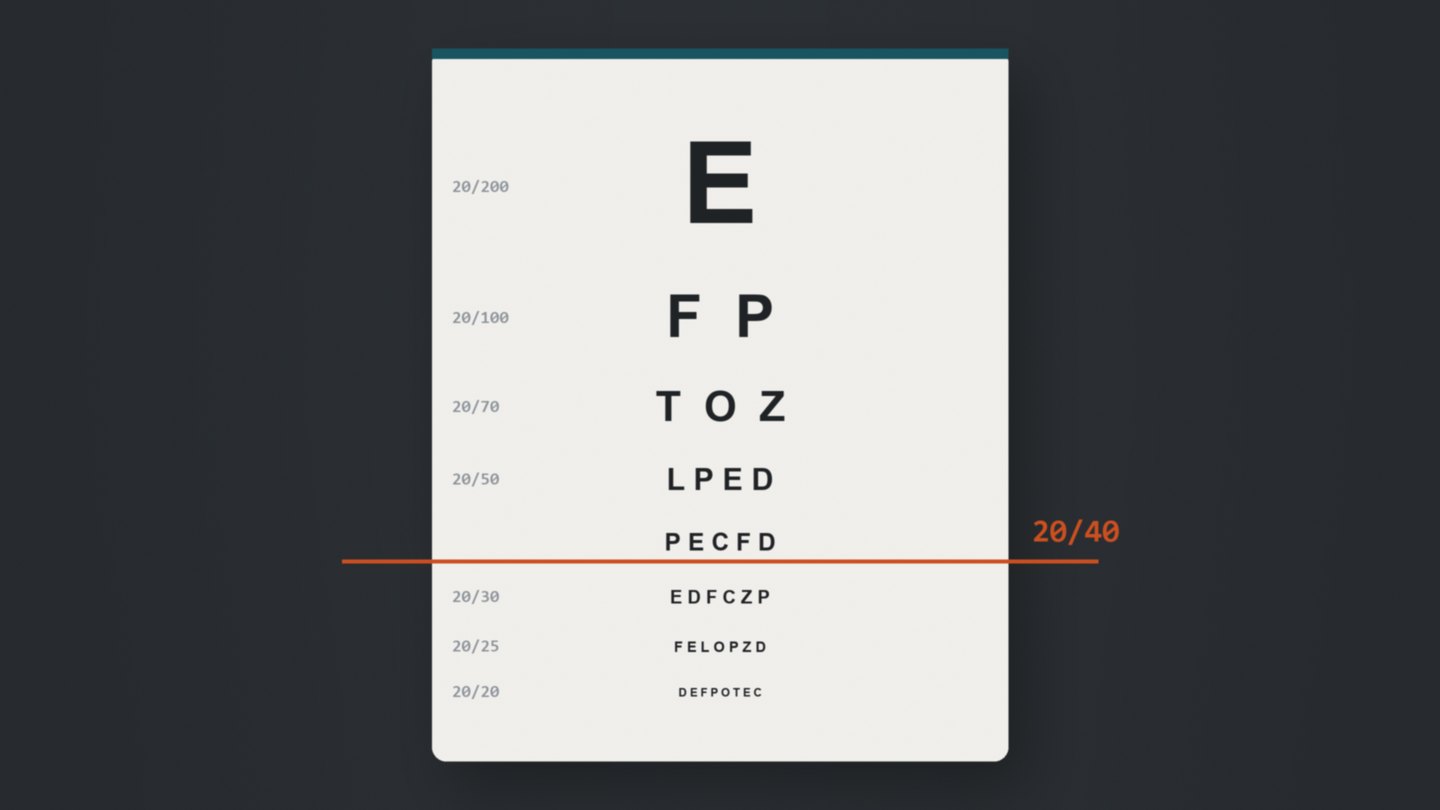
Almost every conversation about the DMV eye test comes back to one number: 20/40. It comes from the Snellen scale, the familiar chart with a big letter at the top and rows that shrink as you go down.
The first number is your distance from the chart, twenty feet. The second is the distance at which a person with typical eyesight could read the same line. So 20/40 means that what you can make out at twenty feet, a typical eye could read from forty. It is not perfect vision, and it isn't meant to be. It is the point at which licensing agencies have decided you can read road signs and spot hazards in time to react.
Two details matter more than people expect. First, the standard is almost always "with or without corrective lenses" — glasses and contacts count. Second, several states look at each eye separately as well as both together, which is how someone with one strong eye and one weak one can pass in one state and be sent for a doctor's report in another.
What happens at the counter
The screening itself comes in two common forms. Some offices still use a printed chart on the wall. Many use a tabletop vision screener: you rest your forehead against a padded bar, look into a viewer, and read the letters or numbers you see on a specific line when the clerk asks. Some screeners also flash small lights at the edges of the view to get a rough check of your side vision.
Either way, the clerk is screening, not diagnosing. They are checking whether you clear the line your state requires, and nothing else. They cannot tell you whether you need a new prescription, and a pass does not mean your eyes are healthy.
You will see search results promising "answers" or a "cheat sheet" for the DMV eye machine. Leave them alone. The screeners show different lines and sequences, clerks can switch slides, and memorizing a row only postpones the moment you find out, in traffic, that you cannot actually read a sign at night. If you are worried about passing, that is a reason to see an eye doctor before your appointment, not to guess better.
Bring your glasses even if you think you don't need them. If you pass wearing corrective lenses, most states print a corrective-lens restriction on your license, and driving without them becomes a violation. If you had LASIK or cataract surgery and still carry that restriction from an old card, ask at the counter how to have it removed — some states want an eye doctor's report first.
The standard is not the same everywhere
There is no single national vision rule for ordinary drivers. Each state sets its own, and the differences are real. Four examples, taken directly from the agencies that enforce them:
California asks for 20/40 with both eyes together and 20/40 in one eye with at least 20/70 in the other, with or without corrective lenses. That dual requirement is stricter than it sounds: a driver with one very weak eye can fail even if their combined vision is fine.
New York requires at least 20/40 in either or both eyes, with or without corrective lenses. Where California checks the weaker eye too, New York is satisfied if one eye meets the line.
Virginia ties the result to what kind of license you get. 20/40 or better in one or both eyes, plus at least 110 degrees of horizontal vision, earns an unrestricted license. 20/70 or better with at least 70 degrees earns a daylight-only license, which allows driving from half an hour after sunrise until half an hour before sunset.
Florida sets its minimum at 20/70 in either eye or both eyes together, with or without corrective lenses. If one eye is blind or measures 20/200 or worse, the other eye has to reach 20/40. Florida also requires a field of vision of at least 130 degrees.
If you have recently moved, this is worth a second look: vision you have driven on for years may not meet your new state's line. Our guide to moving to another state covers the rest of the transfer, and the state directory links to each agency's own rules.
If you fail the screening
This is the part nobody tells you, so here it is plainly: failing the DMV screening does not normally mean you lose your license on the spot. It means the DMV wants a professional opinion before it decides anything. The route looks roughly the same everywhere.
- You are handed a form for an eye doctor. The DMV asks you to see an optometrist or ophthalmologist, who examines you and fills in the state's vision report.
- The doctor records what the screening could not. Best corrected acuity, field of vision, and any condition that affects driving. Often the "failure" was simply an outdated prescription, and the fix is new glasses.
- You return the form. Some states let the doctor submit results electronically; others want the paper back at an office or by mail.
- The DMV decides. Usually a pass with a corrective-lens restriction. Sometimes a restricted license, a driving test, or a referral to the state's medical review unit.
The forms have names, and knowing them saves a phone call. In California it is the DL 62, the Report of Vision Examination. California is explicit that it does not issue temporary licenses or extensions to drivers who failed the screening until a completed DL 62 has been reviewed. After review, the DMV may schedule a drive test or a Supplemental Driving Performance Evaluation, issue a restricted license, or — if the condition makes driving unsafe — revoke it. Applicants whose acuity is 20/200 or worse cannot be scheduled for a drive test at all.
In New York, the everyday form is the MV-619 eye test report, which doctors, nurses, vision care professionals and, through the DMV's Vision Registry, enrolled pharmacists can complete. Results expire twelve months after the test, though the provider can limit that to six. Drivers who cannot meet the basic standard, or who use telescopic lenses, go through the MV-80L and the DMV's Medical Review Unit instead.
Watch the calendar. In states like California there is no temporary paper to tide you over while the vision report is pending. If your license is about to expire, fail the screening early in your renewal window rather than on the last day — it leaves time to see a doctor before the card runs out.
When you will be tested again
A vision screening is standard when you first apply — it is part of getting a learner's permit — and in many states it comes back at renewal. How often depends on the state and, increasingly, on your age.
Florida is a clear example. Drivers 80 and older must pass a vision test at every renewal, either at a driver license office or by having an eye doctor submit the results, and they renew every six years. If you are in that group and want to renew online, the vision results have to be on file first. New York asks for a vision test when you apply for or renew a license, and the renewed license lasts eight years.
That age-based trigger is also why online renewal sometimes stops working for no obvious reason: the system is waiting for a vision result it does not have. Our license renewal guide explains the three ways to renew, and the state pages for California, New York, Florida and Virginia go into each one's process.
Your eyesight can also become the DMV's business between renewals. If a condition changes your vision, many states expect you to report it, and a doctor, family member or police officer can sometimes refer a driver for review. That is a separate process from the routine screening, and it usually goes through the same medical review unit.
Commercial drivers play by stricter rules
Truck and bus drivers answer to a federal standard on top of their state's. Under 49 CFR 391.41, a commercial driver needs distant visual acuity of at least 20/40 in each eye — with or without corrective lenses — and 20/40 in both eyes together, a field of vision of at least 70 degrees in the horizontal meridian in each eye, and the ability to recognize the standard red, green and amber of traffic signals.
The key difference is "each eye". An ordinary license in New York or Virginia can be earned on one good eye; a commercial license generally cannot. Federal rules do offer an alternative vision standard for drivers who fall short, under 391.44, but it involves examinations and paperwork of its own. Some states add their own requirements on top — Virginia asks commercial applicants for 140 degrees of horizontal vision, and does not allow telescopic lenses to be used to meet it. Our commercial license guide covers the rest of the CDL process.
How to walk in ready
None of this needs studying. It needs a little planning.
- Get an eye exam if your last one was years ago. Squinting at road signs, halos around headlights at night, or reading more easily with one eye closed are all reasons to go before the DMV, not after.
- Wear whatever you drive in. Glasses, contacts, both. Bring the glasses even if you wear contacts, in case a lens is irritating that morning.
- Don't book after a long screen session or a bad night. Tired, dry eyes read worse. It sounds trivial, and it can be the difference on a borderline line.
- If you already know you're borderline, bring the form with you. Many states post their vision report online. Having your eye doctor fill it in beforehand can turn a second trip into a single one.
- Check your state's rules before the visit. The standard, the form and the renewal age all vary. The DMV office finder and your state's page in our directory are the fastest way in.
If you are also upgrading to a star-marked card on the same trip, the document list is the bigger hurdle. What happens at the airport without REAL ID explains whether you need one at all.